Display of periodic signals on the oscilloscope
Build the following circuit in figure 1 with the function generator and the oscilloscope.

Fig. 1: Periodic signals on the oscilloscope
Set the signals listed in table 1 on the function generator and draw the corresponding oscilloscope screen images. The signal display on the oscilloscope should optimally fill the screen

Also document the settings of the used channels, the time base, and the GND line on the left side of the screen drawings.
 Fig. 2: Sine, f = 1 kHz, U = 1.8V
Channel 1: $ \frac{V}{\rm DIV} = $
Time basis: $ \frac{T}{\rm DIV} = $
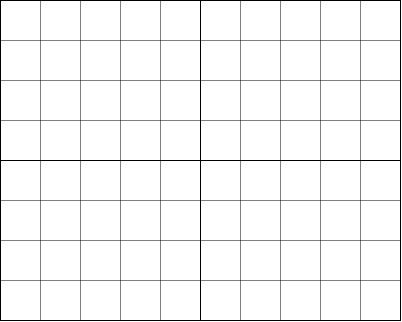 Fig. 3: Triangle, f = 4 kHz, U = 3 V
Channel 1: $ \frac{V}{\rm DIV} = $
Time basis: $ \frac{T}{\rm DIV} = $
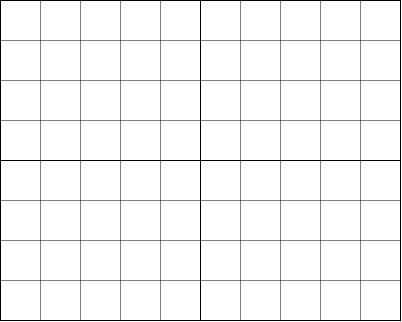 Fig. 4: Rectangle, unipolar, f = 2 kHz, U = 5 V
Channel 1: $ \frac{V}{\rm DIV} = $
Fig. 4: Rectangle, unipolar, f = 2 kHz, U = 5 V
Channel 1: $ \frac{V}{\rm DIV} = $
Time basis: $ \frac{T}{\rm DIV} = $
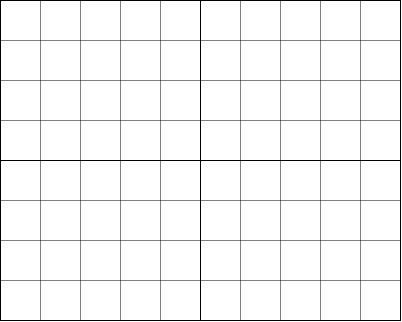 Fig. 5: Rectangle, bipolar, f = 5 kHz, U = 2 V
Channel 1: $ \frac{V}{\rm DIV} = $
Time basis: $ \frac{T}{\rm DIV} = $
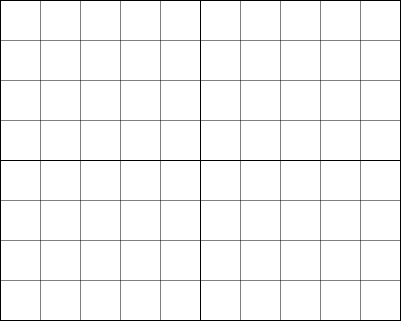 Fig. 6: Sine DC Offset, f = 2.5 kHz, U = 4 V, UDC = 2 V
Channel 1: $ \frac{V}{\rm DIV} = $
Time basis: $ \frac{T}{\rm DIV} = $