Capacitors
Direct capacitance measurement
Capacitors are components that allow the storage of electrical energy. In the charged state an electrical charge is present. This charge causes a voltage at the electrical terminals of the capacitor.
Build the following circuit on the breadboard with three capacitors, s. figure 1:

Measure the capacitance of capacitors $C_{\rm 1}$, $~C_{\rm 2}$, $~C_{\rm 3}$ with the multimeter and enter the measured values in table 1.

Capacitors can be connected in series and/or in parallel. The total capacitance of two or more capacitors in parallel is calculated as:
$$C_{\rm total} = C_{\rm 1} + C_{\rm 2} + ... + C_{\rm n}$$
The total capacitance of capacitors connected in series is calculated as:
$$ \frac{1}{C_{\rm total}} = \frac{1}{C_{\rm 1}} + \frac{1}{C_{\rm 2}} + ... + \frac{1}{C_{\rm n}}$$
Series connection:
- $C_{\rm 1}+ C_{\rm 2}$ (measured between terminals 1 and 3)
- $C_{\rm 2}+ C_{\rm 3}$ (measured between terminals 3 and 4)
Parallel connection:
- $C_{\rm 1~} || ~C_{\rm 3}$ (measured between terminals 1 and 2; wire bridge between 1 and 4)
- $C_{\rm 1~} || ~C_{\rm 2}$ (measured between terminals 1 and 2; wire bridge between 1 and 3)
Series/parallel connection:
- $C_{\rm 1~}+(C_{\rm 2~} || ~C_{\rm 3})$ (measured between terminals 1 and 3; wire bridge between 3 and 4)
Enter the measured and calculated values in table 2.

The built-in capacitors have values from the E6 series. The E6 series for capacities is shown below. For the measured capacities from table 1, determine the matching value from the E6 series and calculate the respective measurement deviation from the nominal value in %.
$$ \text{Deviation} = \frac{C_{\rm meas}-C_{\rm nom, E6 series}}{C_{\rm nom, E6 series}}\cdot 100% $$
Enter your results in the spaces provided below.
$C_{\rm 1~} (E6)~=~ {\rm ....................~} ({\rm Deviation ............}{\%})$
$C_{\rm 2~} (E6)~=~ {\rm ....................~} ({\rm Deviation ............}{\%})$
$C_{\rm 3~} (E6)~=~ {\rm ....................~} ({\rm Deviation ............}{\%})$
The E6 series for capacities in table 3:

RC network
The capacitance of a capacitor is defined as the quotient of charge by voltage: $$ C=\frac{Q}{U} $$
Capacitors must be charged via an electrical source figure 2.

A capacitor charges the faster the smaller the series resistor $R$ is. During charging, the voltage $u_{\rm C}$ results from a differential equation as: $$ u_{\rm C}({\rm t})=U\cdot ({\rm 1}-e^{-\frac{t}{\tau}}), {\rm with~~} \tau = R\cdot C $$
The constant $\tau$ is called the time constant. After this time, the capacitor is charged to approx. ${\rm 63}~{\rm\%}$. The fundamental equation for the relation between current and voltage at a capacitor is:
$$ i_{\rm C}({\rm t})=C\cdot \frac{{\rm d}u_{\rm C}}{{\rm dt}} $$
From the two equations, the current through the capacitor is: $$ i_{\rm C}({\rm t})=\frac{U}{R}\cdot e^{-\frac{t}{\tau}} $$
The graphical representation of voltage and current during the charging of a capacitor over time is shown in figure 3.
 Fig. 3: Voltage/Current in case of charging capacitor
Because of the exponential function, charging is theoretically only complete after an infinitely long time. The capacitor voltage equals ${\rm 63}~{\rm\%~} U$ after ${\rm 1}\cdot \tau$, ${\rm 86}~{\rm\%~} U$ after ${\rm 2}\cdot \tau$, ${\rm 95}~{\rm\%~} U$ after ${\rm 3}\cdot \tau$, ${\rm 98}~{\rm\%~} U$ after ${\rm 4}\cdot \tau$, and ${\rm 99}~{\rm\%~} U$ after ${\rm 5}\cdot \tau$. It is assumed that the capacitor is fully charged after a time span $T = {\rm 5}\cdot \tau$ and the voltage across the capacitor has reached $U$. If the charged capacitor $C$ is discharged through a resistor $R$, the solution of the differential equation for the voltage is:
$$ u_{\rm C}({\rm t})=U\cdot e^{-\frac{t}{\tau}} $$
For the current accordingly:
$$ i_{\rm C}({\rm t})=- \frac{U}{R}\cdot e^{-\frac{t}{\tau}} $$
Now build the following circuit. Connect the function generator and the oscilloscope to the circuit as shown in figure 4.
 Fig. 4: Circuit with oscilloscope + function generator
Connect the function generator’s ground (black) to point 2 and the signal lead to point 1. For the oscilloscope connection use the BNC‑banana adapter; the red socket is the signal input and the black socket is the ground connection to the oscilloscope. Connect Channel 1 to point 3, Channel 2 to point 4, and ground to point 5. You only need to make the ground connection to the oscilloscope once, since the ground lines are connected inside the oscilloscope.
Enter in table 4 both the measured values of the components used and the calculated time constant $\tau$.

Set the voltage $u_{\rm F}$ generated by the function generator to a unipolar square with amplitude 5 $V$ (i.e., no negative signal voltages occur!). The frequency on the function generator must be chosen so that the capacitor just fully charges and then fully discharges again.
Calculate the frequency to be set:
$f_{\rm 1} =~{\rm ...............}$
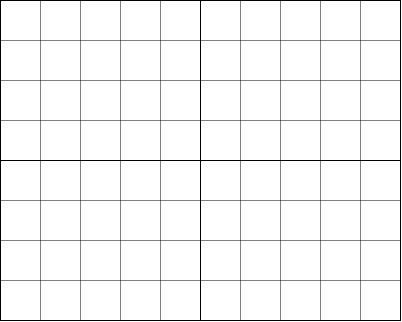
Sketch the voltages measured with the oscilloscope for $u_{\rm F}$, $u_{\rm C}$, and $u_{\rm R}$ in the following screen diagram. Also enter alongside the screen drawings the set $\frac{V}{\rm DIV}$ of the channels and the $\frac{T}{\rm DIV}$ of the time base.
Channel 1: $ \frac{V}{\rm DIV} = $
Channel 2: $ \frac{V}{\rm DIV} = $
Time basis: $ \frac{T}{\rm DIV} = $
Draw tangents in the screen diagram for the start of charging and the start of discharging.
What is the charging current or discharging current at the beginning?
${\rm ........................................................................................}$
${\rm ........................................................................................}$
The circuit is now to be operated at higher frequencies. Set the frequency to:
- $f_{\rm 2} = ~{\rm 10}\cdot f_{\rm 1}$
- $f_{\rm 3} = ~{\rm 100}\cdot f_{\rm 1}$
Measure the waveforms for $u_{\rm F}$, $u_{\rm C}$ and document the results in the following table 5:

Explain your observations for the measurements with $f_{\rm 2}$, $f_{\rm 3}$:
${\rm ........................................................................................}$
${\rm ........................................................................................}$
${\rm ........................................................................................}$
${\rm ........................................................................................}$